For Emergencies Dial 911 | Administration: 815-478-3197
Content Sections
Text
Although we protect our businesses from fire, what actions do we take to protect our families, our homes, and our possessions from a fire? Millions of Americans have installed smoke alarms in their homes in the past few decades, but a smoke alarm can only alert the occupants to a fire in the house- it cannot contain or extinguish a fire. Residential sprinkler systems can!
Fires in residences have taken a high toll on life and property. In 2010 there were:
- 362,100 residential building fires
- 2,555 civilian fire deaths
- 13,275 civilian fire injuries
- $6.6 billion in property damage
Studies by the Federal Emergency Management Agency’s United States Fire Administration indicate that the installation of home fire sprinkler systems could have saved thousands of lives; prevented a large portion of those injuries, and eliminated hundreds of millions of dollars in property losses.
Text
Using quick response sprinklers and approved piping, homes can be built or even retrofitted to include low-cost automatic sprinkler systems connected to the domestic water supply.
Sprinkler systems offer advantages to the homebuilder:
- A low-cost reliable safety option that would attract many buyers.
- Trade-offs between sprinklers and code requirements can result in lower construction costs, more units per area of land, etc. (5 to 15 percent)
- For homeowners, the advantages include assurance of a safer environment for their families, protection of their investment and irreplaceable family possessions, and lower insurance rates of 5 to 15 percent.
Fast Response
Residential sprinklers, listed by Underwriters Labs, are now available. They are designed to respond to a fire much faster than standard commercial and industrial sprinkler systems. The new home sprinklers react automatically to fires more quickly because of the improved sensitivity.
Low Cost
At the present time, the cost of a home sprinkler system is targeted at approximately $1.61 per square foot in new construction. It is hoped that the cost will decrease as the use of home fire protection grows. It is also possible to retrofit existing homes with sprinkler systems.
Small Size
For residential systems, the sprinklers will be smaller than traditional, commercial, and industrial sprinklers, and can be aesthetically coordinated with any room décor.
Minimal Installation Work
When homes are under construction or being remodeled, a home sprinkler system will require minimal extra piping and labor.
Low Water Requirement
These systems will require less water than the systems installed in industrial or commercial establishments and can be connected to the domestic water supply.
A Growing Number of Communities Promote Home Fire Sprinklers
The fire loss in this country in residential occupancies is alarming. Manual firefighting methods are not the answer. The way to attack the problem is to limit the fire growth where it occurs in dwellings. We have the technology to do that.
Text
Home Fire Risk in One- and Two-Family Homes
Six people die in home fires every day. According to the National Fire Protection Association (NFPA) Fire Loss in the U.S. During 2020, home fires caused:
- 2,230 civilian fire deaths, 85% of all residential fire deaths.
- 8,600 injuries.
- $6.8 billion in direct property damage.
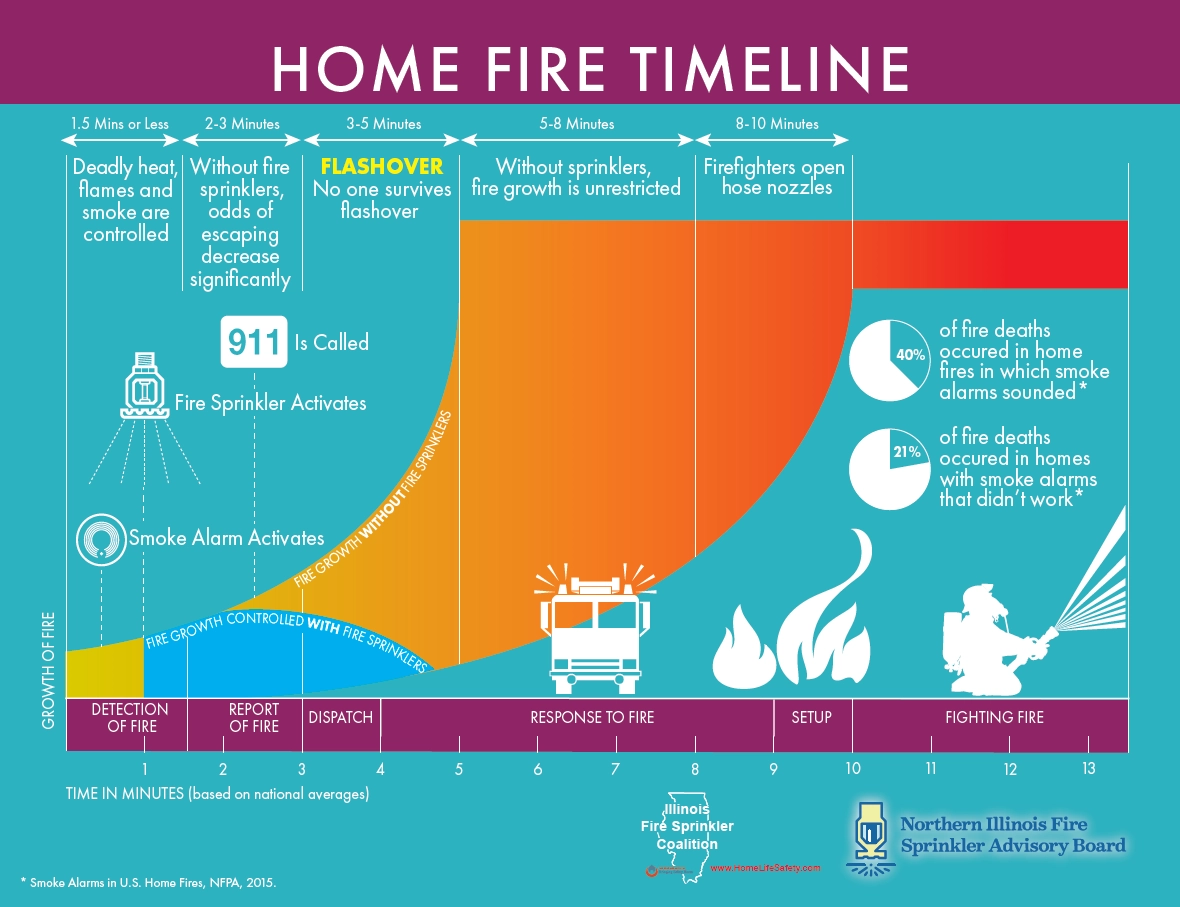
Today’s one- and two-family homes are dangerous for residents and first responders (UL/NIST), burning faster and failing quicker (even collapsing). A home fire can become deadly in as little as two minutes. Homes burn faster due to modern home furnishings, more open spaces and unprotected lightweight wood construction.
Home Fire Mitigation
Fire sprinkler technology has been protecting a wide range of structures for more than a century, but their use has been slow to catch on in homes. The NFPA found that sprinklers were present in only 7% of 2021 home fires. Only California, Maryland and Washington, D.C. require statewide installation of sprinklers in new-home construction.
Broader installation of home fire sprinklers would save thousands of lives (USFA). Installing home fire sprinklers uniquely protects residents, property and the firefighters who respond to fires in these structures. According to the NFPA, the 2021 civilian fire death rate was 89% lower in structures with installed fire sprinklers. The rate of firefighter injuries was 60% lower in fires with sprinklers than in fires without sprinklers.
Home Fire Activation
If a fire occurs, the sprinkler closest to it activates automatically, in response to the high heat from a fire. That controls (often extinguishes) the flames, reduces the spread of toxic and damaging smoke and provides time for occupants to escape. When sprinklers are present, fire is kept to the room of origin 96% of the time (NFPA). In most home fires, only one or two sprinklers will control the blaze. In fires in unsprinklered homes, the toxic smoke spreads widely and more area is exposed to heat, smoke, and fire. This requires more water to be used for suppression with powerful fire department hoses. This greatly increases water and fire damage to the structure and contents.
First Responders
Installing home fire sprinklers helps communities in many ways, including protecting first responders from fire and exposure hazards. Today’s home fires are dangerous for firefighters as well as occupants. Firefighters are 11 times more likely to be injured fighting structure fires; 87% of their injuries occur there (USFA 2019). The risk is not limited to fire exposure. Firefighters today face a 9% increase in cancer diagnoses and a 14% increase in cancer-related deaths, compared to the general population in the U.S. (National Institute for Occupational Safety and Health 2017)
Environment
Home fire sprinklers also protect property and the environment. In 2010, FM Global conducted a groundbreaking study of the environmental impact of fire sprinklers. Their research proved that sprinklers are green:
- Greenhouse gas emissions were cut by 97.8%
- Water usage was reduced between 50% and 91%
- Fewer persistent pollutants, such as heavy metals, were found in sprinkler wastewater versus fire hose water
- The high pH level and pollutant load of non-sprinkler wastewater are an environmental concern
In 2021, FM Global reaffirmed this important study, publishing the Environmental Impact of Residential Fires Review, documenting that since 2010:
- 1.8 billion lbs. of greenhouse gases have been emitted into the atmosphere due to the lack of home fire sprinklers.
- Installed home fire sprinklers would have reduced greenhouse gas emissions by 97% to 54 million lbs.
Homebuyers
Today’s homebuyers want smarter homes. In a recent national fire safety survey* of more than 2000 adults of all ages, 86% said fire safety was important as they look to buy a new home. After learning how home fire sprinklers work, 80 percent of millennials, the largest age group buying homes, said they would prefer to buy a home with fire sprinklers.
- HFSC Omnibus survey with Opinium, surveying a nationally representative sample of more than 2,000 US adults.
NFPA Reports:
US Experience with Sprinklers, Marty Ahrens October 2021: https://www.nfpa.org/News-and-Research/Data-research-and-tools/Suppression/US-Experience-with-Sprinklers
Fire Loss in the United States During 2020, Marty Ahrens and Ben Evarts September 2021: https://www.nfpa.org/News-and-Research/Data-research-and-tools/US-Fire-Problem/Fire-loss-in-the-United-States
Help Us Help You!
Description
We are interested in your opinion about any recent Emergency services or Public Education services you received from the Manhattan Fire Protection District.
Please help us to improve our services by submitting these surveys!